
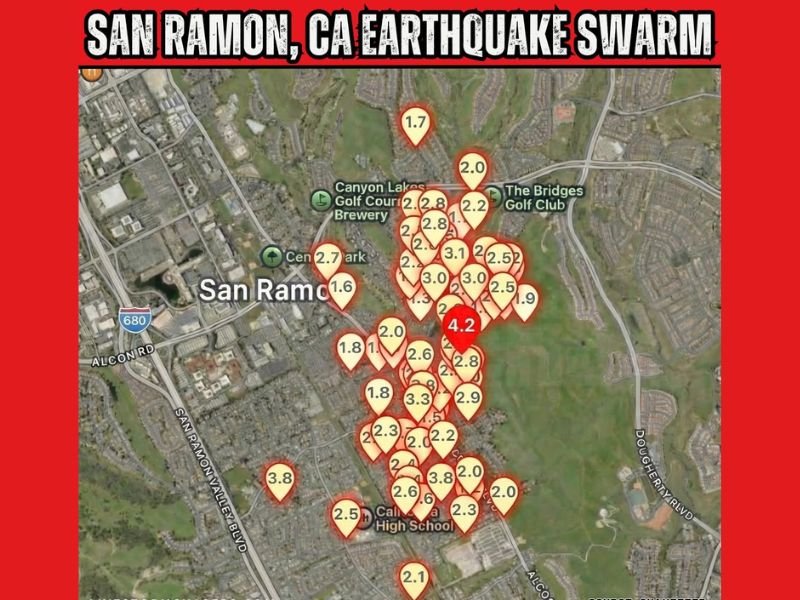
SAN RAMON, CALIFORNIA — An earthquake swarm has shaken San Ramon over the past 24 hours, with the U.S. Geological Survey reporting more than 60 earthquakes in and around the city. A map of the activity shows a tightly packed cluster of tremors across neighborhoods near major roads, schools and well-known local landmarks.
Dozens of Small Quakes Clustered in a Tight Area
The plotted epicenters show repeated shaking concentrated in a narrow zone rather than spread widely across the region. The swarm appears centered around areas near Canyon Lakes Golf Course & Brewery and The Bridges Golf Club, with many quake markers stacked close together, indicating frequent, closely spaced events.
Nearby reference points on the map include the I-680 corridor, Alcosta Boulevard, and Dougherty Road, underscoring how close the activity is to everyday traffic routes and residential areas.
Most Quakes Were Small, But One Stronger 4.2 Stands Out
While many of the earthquakes displayed on the map fall into the lower-magnitude range, the swarm includes a more notable event marked at magnitude 4.2. Surrounding that stronger shake are numerous smaller earthquakes, commonly in the 1.6 to 3.8 range, reflecting a classic swarm pattern where repeated tremors occur without a single dominant mainshock.
Because swarms can evolve, residents may continue to feel sporadic shaking as the sequence plays out.
Activity Appears Near Cal High School and Central San Ramon Areas
The map’s southern portion shows quake markers near Cal High School, highlighting that the repeated tremors are occurring close to community hubs. Additional markers extend toward central San Ramon, with scattered events reaching outward while the densest concentration remains in the same core area.
Even when magnitudes are small, repeated shaking can be unsettling, particularly when quakes occur back-to-back over many hours.
What Residents Should Watch for During an Active Swarm
Earthquake swarms often bring uncertainty because the pattern can fade quickly or continue longer than expected. Officials typically urge people in active areas to be ready for sudden shaking, secure loose items at home, and review basic safety steps like “Drop, Cover, and Hold On” if another tremor hits.
Residents are also encouraged to monitor official quake updates as scientists track whether the cluster grows, shifts location, or produces additional stronger events.
For continued coverage of West Coast hazards and regional impact updates, stay connected with WingsPNW.com.
Leave a Reply